
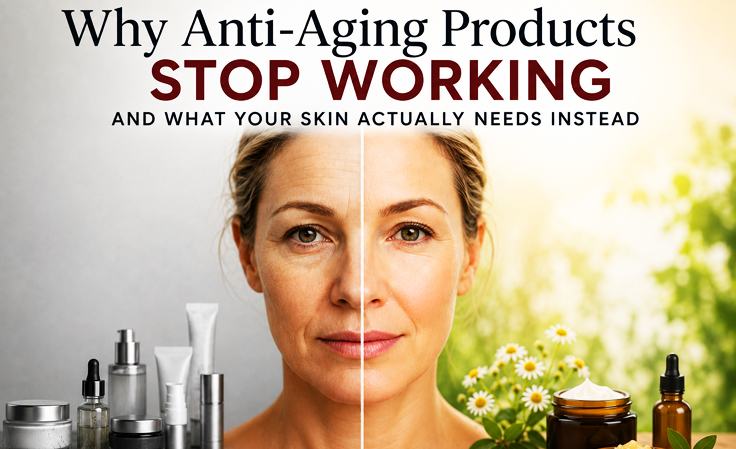
There is a quiet moment many people experience somewhere in their thirties or forties. It usually happens in the mirror. You’re using better products than ever before. More expensive ones. More “advanced” ones.
You’ve upgraded your routine, followed the directions, maybe even simplified like everyone told you to. And yet… your skin doesn’t look better. In some cases, it looks worse. Drier. Thinner. More reactive. Lines seem sharper instead of softer. Glow feels fleeting instead of lasting. Here are five signs you skin barrier is damaged, and you might not even know.
This moment is confusing because we’ve been taught to believe that anti-aging skincare works in a straight line. Use the right products, apply them consistently, and your skin should respond. So when it doesn’t, the assumption is often that you need something stronger, newer, or more aggressive.
But what if the problem isn’t that anti-aging skincare stopped working because your skin failed… but because the approach itself is flawed?
Understanding why anti-aging products stop working requires us to step back from marketing claims and look at how skin actually ages, how it protects itself, and what it truly needs as time goes on.
The Hidden Assumption Behind Most Anti-Aging Skincare
Most conventional anti-aging products are built on one core assumption: that aging skin needs to be corrected, stimulated, or forced into behaving like younger skin. This belief has shaped decades of product development focused on exfoliation, resurfacing, tightening, and accelerating cell turnover.
At first, this approach can appear effective. Skin looks smoother after exfoliation. Fine lines blur when the surface is temporarily plumped. Texture improves when inflammation triggers short-term renewal. These early results are seductive, and they reinforce the idea that stronger is better.
But skin is not a machine that responds indefinitely to pressure. Over time, constant stimulation begins to exhaust it. The barrier weakens. Natural oil production declines further. Sensitivity increases. Suddenly, products that once worked now sting, dry, or irritate. Anti-aging skincare stops working not because aging accelerated, but because the skin’s protective systems have been slowly worn down.
This is where many people feel stuck, cycling through products that promise renewal while quietly contributing to depletion.
Why Anti-Aging Skincare Stops Working Over Time
One of the most common reasons anti-aging skincare stops working is barrier damage. The skin barrier is a lipid-based structure designed to protect against moisture loss, environmental stress, and inflammation. As we age, lipid production naturally declines, making the barrier more vulnerable even before products enter the picture.
Many conventional anti-aging formulas unintentionally accelerate this decline. Water-based serums dominate the market because they feel light and absorb quickly, but they rely on emulsifiers, preservatives, and penetration enhancers to function. These additives can disrupt the barrier, allowing moisture to escape faster and leaving skin more dependent on constant product application.
Exfoliating acids, retinoids, and “active” ingredients further compound the issue. While they can stimulate turnover, they also thin the outer layers of skin when overused, making fine lines appear deeper and skin more fragile. This is why I do not use retinol. Over time, the skin enters a cycle of chronic low-grade inflammation, which is one of the primary drivers of visible aging.
This is why so many people searching “why anti aging skincare not working” feel like their skin is aging faster despite using more products than ever before.
Why Aging Skin Isn’t Lazy—It’s Depleted
Aging skin doesn’t fail because it stops trying. It changes because it has fewer resources. With age, the skin produces less sebum, fewer ceramides, and less natural antioxidant protection. Collagen and elastin decline, not because the skin forgets how to make them, but because the environment needed to support that production weakens.
When anti-aging products focus only on stimulation without replenishment, they ask aging skin to perform without giving it what it needs to rebuild. It’s like demanding productivity from soil that’s been stripped of nutrients. You might get short bursts of growth, but eventually, the system collapses.
What aging skin actually needs is not constant correction, but nourishment. It needs lipids to rebuild its barrier, calm inflammation, and retain moisture naturally. Without this foundation, no amount of “active” ingredients can deliver lasting results.
The Role of Skin Barrier Aging
Skin barrier aging is one of the most overlooked contributors to visible aging. When the barrier weakens, water escapes more easily, leading to chronic dehydration even when skin feels oily on the surface. Inflammation increases as irritants penetrate more easily. Fine lines deepen as the skin loses elasticity and resilience.
This process often masquerades as “normal aging,” but much of it is accelerated by product choices. The irony is that many anti-aging products marketed to address wrinkles and texture actively worsen barrier decline.
When people begin to understand barrier health, they often experience a shift. Skin becomes calmer. Texture improves. Glow lasts longer. Lines soften not because they’re erased, but because the skin is better supported.
This is where oil-based skincare enters the conversation, not as a trend, but as a return to biological logic.
Why Oil-Based Anti-Aging Serums Work Differently
Oil-based anti-aging serums work on a fundamentally different principle than water-based products. Instead of flooding the skin with hydration that evaporates, oils integrate into the lipid matrix of the skin barrier, reinforcing it from within.
The skin recognizes oils. Lipids are not foreign to it; they are structural. When applied consistently, oil-based serums help reduce transepidermal water loss, calm inflammation, and improve elasticity. This creates an environment where the skin can repair itself more effectively, rather than constantly responding to stress.
Unlike water-based serums that rely on chemical penetration enhancers, oil-based formulas don’t need to force absorption. They work with the skin’s natural structure, which is why they are often better tolerated by sensitive, mature, oily, dry, and combination skin alike.
This is also why oil-based anti-aging serums tend to produce slower but more durable results. They support function, not illusion.
Why Hormone Safety Matters in Anti-Aging Skincare
One of the most important yet least discussed reasons anti-aging products stop working is hormonal interference. The skin is an endocrine organ. Ingredients applied topically can influence hormone signaling, especially when used daily over long periods.
Many conventional anti-aging products contain synthetic fragrance, preservatives, and lab-derived compounds that act as endocrine disruptors. These ingredients may not cause immediate reactions, but over time they can interfere with the body’s delicate hormonal balance, contributing to inflammation, sensitivity, and accelerated aging.
This is particularly relevant for women navigating hormonal transitions such as postpartum recovery, perimenopause, menopause, or chronic stress. Using hormone-disrupting skincare during these seasons adds an invisible burden the skin must compensate for.
Hormone-safe skincare removes that obstacle. It allows the skin to heal and regulate itself without fighting chemical interference.
Why Natural Anti-Aging Skincare Is Gaining Ground
Natural anti-aging skincare is not about rejecting science. It’s about applying biological understanding. The skin functions with fats, antioxidants, and protective compounds found in nature. When skincare aligns with how it is designed, the skin responds with resilience rather than resistance.
This is why many people who switch to oil-based, hormone-safe products report that their skin feels calmer almost immediately. The reduction in inflammation alone can change how skin looks and behaves within weeks.
Over time, nourishment compounds. Fine lines soften. Tone evens out. Skin feels stronger instead of fragile. These changes don’t disappear when you skip a day or step into dry air. They reflect improved skin health, not surface-level correction.
How Arvoti Anti Aging Serum Fits Into This Shift
Arvoti Anti Aging Serum was formulated for people who are tired of chasing stronger products and ready to support their skin differently. Instead of relying on water, fillers, or synthetic shortcuts, it is built around nourishing lipids that reinforce the skin barrier and support long-term resilience.
As an oil-based anti-aging serum, it integrates seamlessly with the skin’s natural structure. It doesn’t strip, tighten, or overstimulate. It nourishes. This makes it suitable for all skin types, including sensitive, dry, oily, and aging skin that no longer tolerates aggressive products.
What sets Arvoti Anti Aging Serum apart from conventional store-bought alternatives is its commitment to hormone-safe skincare. It avoids synthetic fragrance and ingredients known to interfere with endocrine signaling. This allows the skin to focus its energy on repair rather than defense.
Rather than promising overnight transformation, this serum supports gradual, meaningful change. Skin feels softer, more elastic, and more balanced. Over time, fine lines soften and glow becomes more consistent because the barrier is functioning properly again.
What Your Skin Actually Needs Instead of More “Anti-Aging”
If anti-aging skincare hasn’t been working for you, the answer is rarely another aggressive product. More often, it’s a shift in strategy. Aging skin needs fewer demands and more support. It needs replenishment instead of pressure. It needs stability instead of constant turnover.
Oil-based, hormone-safe skincare provides that support. It restores the foundation so that the skin can age with strength rather than fragility. This is not about reversing time. It’s about aging well, with skin that feels comfortable, resilient, and alive.
When you give skin what it actually needs, it often surprises you with how much it can recover.
Try An Anti-Aging Serum That Works
If you’ve been searching for why anti aging products stop working and feel frustrated that your skincare routine no longer delivers lasting results, consider whether your skin is asking for nourishment instead of stimulation. Arvoti Anti Aging Serum offers a natural, oil-based approach that supports the skin barrier, respects hormonal balance, and works with your skin rather than against it.
Your skin doesn’t need to be forced to look younger. It needs to be supported so it can function at its best.
Frequently Asked Questions
Why do anti-aging products stop working after a while?
Many anti-aging products rely on stimulation and exfoliation, which can weaken the skin barrier over time. Once the barrier is compromised, skin becomes more reactive and less responsive to these products.
Can an oil-based anti-aging serum really help wrinkles?
Oil-based serums support the skin barrier and improve elasticity, which can soften the appearance of fine lines by improving overall skin health rather than forcing surface changes.
Is oil-based skincare suitable for oily or acne-prone skin?
Yes. When properly formulated, oil-based skincare can help regulate oil production and reduce inflammation by repairing the barrier.
Why is hormone-safe skincare important?
Hormone-disrupting ingredients can interfere with skin balance and accelerate aging over time. Hormone-safe skincare removes that burden, allowing the skin to heal more effectively.
How long does it take to see results with Arvoti Anti Aging Serum?
Many people notice improved comfort and softness within days, with visible improvements in tone, texture, and fine lines developing over several weeks of consistent use.
