
If you’ve ever applied a skincare product that promised hydration, glow, firmness, and renewal, only to feel dry again an hour later, you’re not imagining things. Been there. That experience is incredibly common, and it isn’t because your skin is “difficult,” aging too fast, or broken. It’s because most skincare on the market is built on a misunderstanding of how skin actually works.
Oil-based serums operate on an entirely different principle than conventional, water-based products, and once you understand that difference, a lot of skincare confusion suddenly clicks into place. This isn’t about trends or aesthetics. It’s about biology, structure, and nourishment. It’s about working with the skin instead of constantly trying to override it.
To understand why oil-based serums work differently, and often far better, you have to start by understanding what your skin is made of and what it actually needs to thrive. My oil-based serums and even my oil-based cleansers have become a regular part of my skincare routine, and my skin is more supple and glowy than ever. Why? Because I am finally nourishing it correctly.
Your Skin Is Not Thirsty, It’s Hungry
One of the biggest myths in modern skincare is that skin primarily needs water. This idea has driven decades of product development centered around hydration, humectants, and lightweight gels that promise to “flood” the skin with moisture. But biologically speaking, your skin is not designed to hold large amounts of free water on its own.
The outermost layer of your skin, the stratum corneum, is composed largely of lipids, fats that create a protective barrier. These lipids are what keep moisture in and irritants out. When that lipid barrier is intact, skin appears smooth, resilient, plump, and calm. When it’s depleted, water escapes rapidly, inflammation increases, and the skin begins to show signs of aging far earlier than it should.
This is why so many people feel caught in a loop of applying moisturizer repeatedly throughout the day. Water-based products can temporarily make skin feel hydrated, but without enough lipid support, that hydration evaporates. It’s like pouring water into a cracked bucket. No matter how much you add, it never stays.
Oil-based serums don’t attempt to drown the skin in moisture. Instead, they feed it the fats it needs to rebuild the barrier that holds moisture in place.
Why Water-Based Serums Behave the Way They Do
Most store-bought serums are water-based by necessity, not effectiveness. Water is cheap, easy to formulate with, and feels light and cosmetically elegant on the skin. But water-based formulas require emulsifiers, preservatives, stabilizers, and penetration enhancers to remain shelf-stable and usable. Many of these additives are irritating, sensitizing, or disruptive over time, especially for hormonally sensitive skin.
Because water cannot penetrate the lipid-rich barrier effectively on its own, water-based serums rely on chemical shortcuts to force absorption. This often leads to that initial “wow” feeling, tightness, plumpness, tingling, that gets interpreted as results. In reality, those sensations are often signs of barrier disruption or inflammation, not true nourishment.
Over time, repeated use of these products can thin the skin, increase sensitivity, and make the skin more reactive. This is why so many people find that their skincare works for a while, then suddenly stops, or worse, starts causing irritation.
Oil-based serums take a slower, quieter route, but one that aligns far more closely with skin physiology.
Why Oil-Based Serums Speak the Skin’s Language
Skin recognizes oils. That’s not poetic language, it’s literal. The skin barrier is built from lipids, and when you apply a well-formulated oil-based serum, the skin doesn’t have to be coerced into accepting it. The product integrates naturally into the barrier, reinforcing it rather than bypassing it.
Instead of sitting on the surface or evaporating, oils soften the skin, improve elasticity, and reduce transepidermal water loss. They allow the skin to regulate itself again. When the barrier is supported, inflammation decreases, tone evens out, and fine lines soften, not because the product is forcing change, but because the skin is finally functioning the way it was designed to.
This is why oil-based serums often feel different from the first application. There’s no immediate tightening or tingling. Instead, there’s comfort. A sense that the skin has relaxed. Over time, that comfort translates into visible improvement.
Aging Skin Doesn’t Need Aggression, It Needs Nourishment
Modern anti-aging skincare has trained us to think in terms of correction. Correct wrinkles. Correct texture. Correct pigmentation. Correct aging itself. This mindset has led to formulas packed with harsh actives designed to trigger stress responses in the skin in the hope that it will regenerate faster.
But aging skin isn’t lazy. It’s depleted.
As we age, the skin produces fewer lipids, less collagen, and less natural antioxidant protection. The barrier becomes thinner and more permeable. Aggressive treatments may temporarily stimulate turnover, but they often accelerate long-term damage by increasing inflammation and oxidative stress. I repeatedly share the message of why I don't use retinol.
Oil-based serums approach aging from a different angle. They replenish what time and stress have gradually taken away. They support the skin’s ability to repair itself rather than constantly asking it to perform under pressure.
This distinction is especially important for people with sensitive skin, mature skin, acne-prone skin, or hormonally reactive skin, all of which benefit from stability rather than stimulation.
Why Hormone Safety Matters More Than Ever
The skin is not an isolated organ. It communicates with the nervous system, the immune system, and the endocrine system. Ingredients applied to the skin, especially the face, do not simply sit there. Many are absorbed into the bloodstream in small amounts, where they can interact with hormone signaling.
Conventional anti-aging serums often contain synthetic fragrance, chemical preservatives, and lab-derived compounds that act as endocrine disruptors. These ingredients may not cause immediate harm, but over time they can interfere with hormonal balance, particularly in women who are already navigating life stages like postpartum recovery, perimenopause, or chronic stress.
A truly nourishing anti-aging serum should not ask the body to compensate for chemical interference while trying to heal. Oil-based, naturally formulated serums eliminate much of that burden by avoiding hormone-disrupting ingredients altogether.
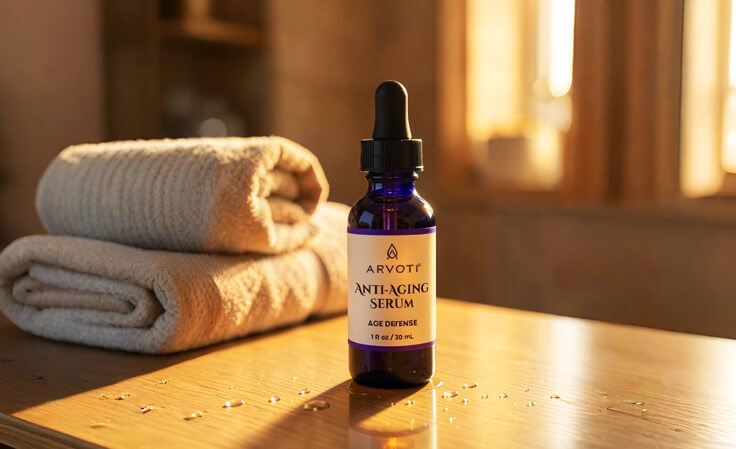
This is where a product like my Arvoti Anti-Aging Serum stands apart. You can learn about other natural remedies for hormonal acne here.
How Arvoti Anti-Aging Serum Works Differently
My Arvoti Anti-Aging Serum was formulated with a fundamentally different philosophy than conventional skincare. Instead of building a product around water, fillers, and synthetic shortcuts, it is designed to nourish the skin with bioavailable lipids that support barrier integrity, elasticity, and long-term resilience.
Because it is oil-based, the serum integrates seamlessly with the skin’s natural structure. It doesn’t fight oil production or attempt to strip and replace. It supports balance. Dry skin feels more supple. Oily skin often becomes more regulated. Combination skin finds equilibrium instead of being pulled in opposing directions.
What makes this serum especially unique is its suitability for all skin types. Contrary to popular belief, oil does not clog pores when properly formulated. In fact, many cases of acne and congestion are rooted in barrier damage and dehydration, not excess oil. By feeding the skin what it needs, oil-based serums can actually reduce overproduction and inflammation.
My Arvoti Anti-Aging Serum is also free from synthetic fragrance and hormone-disrupting additives, making it a safer choice for long-term use. The skin is not asked to tolerate stress in exchange for results. It is supported, day after day, in a way that compounds over time.
Why Results from Oil-Based Serums Look Different, and Last Longer
One of the reasons oil-based serums are often misunderstood is that their results are subtle at first. There is no dramatic overnight transformation. Instead, there is a gradual return to skin that feels calmer, stronger, and more resilient.
Fine lines soften not because they’ve been chemically erased, but because the skin is better nourished and better able to retain moisture. Tone evens out as inflammation decreases. Texture improves as the barrier strengthens. Glow returns as the skin stops operating in a constant state of stress.
These changes are not fragile. They don’t disappear the moment you skip a product or step into dry air. They are signs of improved skin function, not temporary cosmetic effects.
This is the difference between skincare that decorates the surface and skincare that supports the foundation.
A Call to Rethink What “Anti-Aging” Really Means
Aging is not a flaw to be corrected. It is a biological process that can be supported or accelerated depending on how we care for the skin. Oil-based serums invite a quieter, wiser approach, one rooted in nourishment rather than control.
If you’ve felt frustrated by products that promise everything and deliver little, or if your skin has grown more sensitive the longer you’ve tried to “fix” it, it may be time to shift strategies. Supporting the skin’s natural structure, honoring its need for lipids, and choosing hormone-safe formulations can change not just how your skin looks, but how it behaves over time.
My Arvoti Anti-Aging Serum was created for exactly this purpose. It is a return to skincare that respects biology, prioritizes nourishment, and delivers results that build instead of fade.
If you’re ready to experience what oil-based skincare does differently, you can explore my Arvoti Anti-Aging Serum and begin supporting your skin at the foundation level.
Your skin already knows what it needs. Sometimes it just needs the right language.
Frequently Asked Questions
Is an oil-based serum suitable for oily or acne-prone skin?
Yes. When formulated properly, oil-based serums can actually help regulate oil production by repairing the skin barrier. Many cases of oily or acne-prone skin are linked to dehydration and barrier damage, which oil-based serums help correct.
Will an oil-based serum clog pores?
Clogging is typically caused by comedogenic ingredients or barrier disruption, not oil itself. A high-quality oil-based serum designed to support skin function is unlikely to clog pores and may improve congestion over time.
How does an oil-based serum fit into a skincare routine?
Oil-based serums are typically applied after cleansing and before or instead of moisturizer. Because they support the barrier, many people find they need fewer products overall.
Is Arvoti Anti-Aging Serum safe for sensitive or hormonally reactive skin?
Arvoti Anti-Aging Serum is formulated without synthetic fragrance or hormone-disrupting ingredients, making it a gentler option for sensitive and hormonally reactive skin types.
How long does it take to see results with an oil-based serum?
Many people notice improved comfort and softness within days, while visible improvements in tone, texture, and fine lines develop gradually over several weeks of consistent use.
