
There is something deeply grounding about learning how to make your own cheese. Not the complicated, laboratory-style process we’ve been told is necessary. Not the specialty cultures, enzyme tablets, and temperature-controlled aging rooms. Did I mention Pfizer quietly crept in and took over the rennet industry? Yeah, let's avoid that too.
I mean the old-fashioned way. The way our great-grandparents made it in farm kitchens with nothing more than fresh milk, a splash of acid, and patience. If you’ve ever wondered how to make farmers cheese without rennet, you’re about to discover that it’s far simpler, and more beautiful, than modern food culture would have you believe. It was the first cheese I learned how to make on the homestead!
Farmer’s cheese is one of the most forgiving, beginner-friendly cheeses you can make at home. It doesn’t demand precision equipment. It doesn’t require microbial enzymes or fermentation-produced chymosin. It doesn’t even require previous experience. It simply asks for good milk, gentle heat, and trust in a process that humans have relied on for centuries. When people search for a farmers cheese recipe without rennet, what they are really searching for is confidence. They want to know that cheese can still be made the natural way. The reassuring answer is yes.
The Beauty of Homemade Cheese No Rennet Required
The modern cheese aisle would have you believe that rennet is mandatory. Yet for many fresh cheeses around the world, acid, not enzymes, has always done the work. Paneer in India, queso fresco in Mexico, ricotta in Italy, and traditional farmer’s cheese across Eastern Europe were often made with simple acid coagulation. This means the milk proteins separate when exposed to heat and acidity. It is chemistry, yes, but it is also tradition.
Homemade cheese no rennet is not a trendy workaround. It is historically accurate. In fact, rennet was traditionally used for aged cheeses that needed firm curds and long maturation. Farmer’s cheese, by contrast, is meant to be fresh, mild, and eaten within days. It is humble. It is practical. It is the kind of cheese made from the morning’s milking and enjoyed by dinner.
If you’ve ever felt intimidated by cheese-making, let this recipe be your turning point. Think of it like baking sourdough for the first time. At first, it seems mysterious. Then suddenly you realize the ingredients were never the barrier—only your belief that it was complicated.
Why Skip Rennet?
There are many reasons someone may seek a farmers cheese recipe without rennet. Some avoid animal rennet for dietary reasons. Others prefer to avoid microbial or genetically engineered forms. And some simply want to make cheese without ordering specialty ingredients online. Whatever your reason, learning how to make farmers cheese without rennet gives you food independence. It removes reliance on industry and returns the process to your own hands.
When acid is introduced to hot milk, it lowers the pH. Casein proteins destabilize. Curds form. The whey separates. This transformation is almost immediate, and watching it happen feels like witnessing a small kitchen miracle. The first time you see milk divide into curds and whey, it feels almost alchemical. But it is simply the natural structure of milk responding to heat and acidity.
What Does Farmer’s Cheese Taste Like?
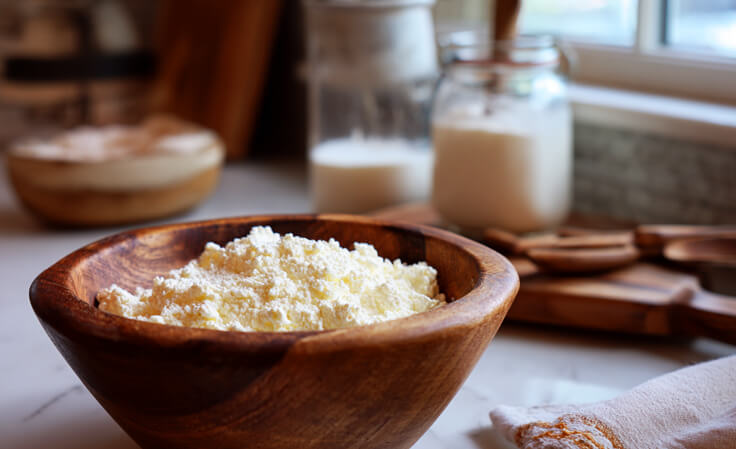
If you have never tasted farmer’s cheese, imagine something between cottage cheese and ricotta, but firmer and less watery. It is mild yet slightly tangy. Creamy but crumbly. It spreads beautifully onto warm sourdough and melts gently into scrambled eggs. It can lean savory or sweet depending on how you season it. Its versatility is part of its charm. Making a sourdough starter is simple, add it to your homestead rotation!
Because this is homemade cheese no rennet, the flavor remains clean and delicate. There are no strong aging notes. No sharpness. Just fresh dairy flavor. If you use high-quality milk, the difference is unmistakable. Good milk equals good cheese. It truly is that simple.
The Milk Matters More Than Anything
When learning how to make farmers cheese without rennet, understand that milk quality determines outcome. Ultra-pasteurized milk often struggles to form proper curds because the proteins have been overly denatured. If possible, choose whole milk that is not ultra-pasteurized. Raw milk works beautifully if it is legally and safely obtained in your area. The cream content contributes to richness and yield. Do whatever is comfortable for you. When I had excess milk from my jersey cow, I would make farmer's cheese!
Using whole milk also aligns with traditional methods. Farmer’s cheese was not skimmed and stripped of fat. It was made from full-bodied milk because that was what the cow gave.
A Skill That Builds Confidence
There is something empowering about realizing you can produce cheese with nothing more than pantry staples. When you learn this process, you stop seeing food as something that only comes packaged. You begin to understand that many “processed” foods were once simple, daily kitchen tasks.
Making homemade cheese no rennet is not just about dairy. It is about reclaiming competence. It is about remembering that food transformation is not exclusive to factories. It belongs in kitchens.
How Long Does Farmer’s Cheese Last?
Because this is a fresh cheese, it does not age like cheddar or parmesan. Stored in an airtight container in the refrigerator, it stays fresh for about three to five days. It is best enjoyed within that window. The moisture content makes it perishable, but it also makes it tender.
Some people gently press it into a small mold for slicing. Others leave it crumbly. The longer it drains, the firmer it becomes. This flexibility allows you to customize texture.
Ways to Use Farmer’s Cheese
Spread it on toast with honey. Crumble it over roasted vegetables. Mix it with herbs and garlic for a dip. Stir it into pasta. Fold it into pancakes. Use it as filling for pierogi or stuffed shells. Once you understand how to make farmers cheese without rennet, you’ll begin seeing it as a blank canvas. When I make homemade lasagna, I make this ahead of time.
It also pairs beautifully with fruit preserves. The tanginess offsets sweetness in a way that feels indulgent yet simple.
Is Homemade Cheese Easy?
Yes. That is the surprising part. The barrier is mental, not technical. Cheese-making feels intimidating because we associate it with complexity. But farmer’s cheese strips the process back to its foundation. You heat milk, you add acid, and you strain curds. That is it. No special enzymes. No aging caves. Just transformation.
Farmer’s Cheese Without Rennet
Ingredients
- 1 Gallon Whole Milk, Preferably not ultra-pasteurized
- 1/4 cup White Vinegar or fresh lemon juice
- 1 tsp sea salt (optional)
Instructions
- Pour the milk into a large heavy-bottomed pot and slowly heat it over medium heat, stirring occasionally to prevent scorching.
- Allow the milk to reach approximately 185–195°F. If you do not have a thermometer, heat until steaming and small bubbles form around the edges, but do not let it reach a rolling boil.
- Once the milk reaches temperature, turn off the heat and slowly stir in the vinegar or lemon juice.
- Watch as the milk begins to separate almost immediately into white curds and yellowish whey.
- Let the mixture sit undisturbed for 10–15 minutes so the curds can fully develop.
- Line a colander with cheesecloth or a clean cotton towel and place it over a bowl.
- Carefully pour the mixture into the lined colander to strain.
- Allow the curds to drain for 10–30 minutes, depending on how firm you prefer the cheese.
- For a firmer texture, gather the cloth and gently press out additional whey.
- Transfer the curds to a bowl, sprinkle with sea salt if desired, and mix gently.
- Shape as desired or leave the cheese crumbly.
- Refrigerate for 1–2 hours before serving to allow it to firm up.
You Can Make Cheese. Truly.
If you’ve been waiting for permission to try, let this be it. Learning how to make farmers cheese without rennet is one of the easiest entry points into traditional food skills. It proves that real food does not require industrial ingredients. It requires willingness.
Try it once. Watch the curds form. Taste the difference. Then come back and tell me you didn’t feel just a little bit more capable.
If this recipe helped you, share it with someone who still thinks cheese-making is complicated. And if you love learning traditional kitchen skills like this, bookmark this page and come back often. There is more to rediscover.
Frequently Asked Questions
Can I use skim milk for a farmers cheese recipe without rennet?
You can, but the yield and richness will be lower because fat contributes to both texture and flavor.
Is homemade cheese no rennet safe?
Yes, when made with fresh milk and clean equipment, acid-coagulated cheeses are very safe and have been made traditionally for centuries.
Can I freeze farmer’s cheese?
Freezing is not ideal because it changes the texture, making it more crumbly once thawed.
What can I use instead of vinegar?
Fresh lemon juice works beautifully and gives a slightly brighter flavor.
Why didn’t my milk separate?
Ultra-pasteurized milk often struggles to form curds properly. Try using whole milk that is not ultra-pasteurized for best results.
