
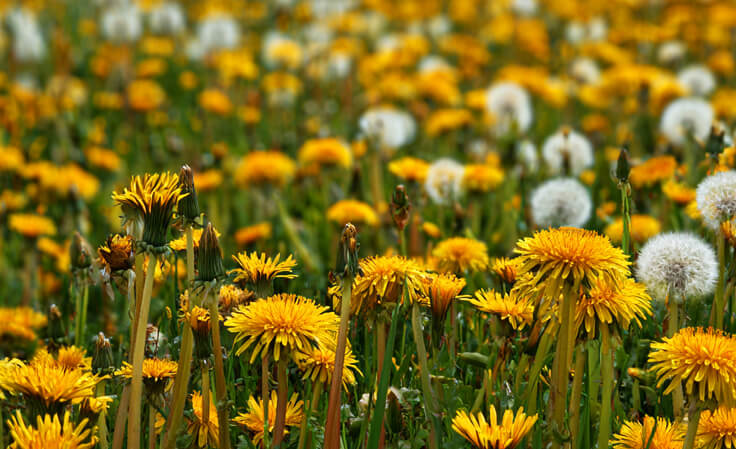
Walk outside in early spring and you’ll notice something that most people have been trained to overlook. Scattered across fields, lining driveways, and quietly taking over patches of lawn, dandelions begin to appear in soft waves of yellow. For some, they’re an eyesore. For others, they’re a signal that it’s time to reach for weed killer. But if you slow down long enough to actually look at them, really look, it raises a deeper question that most people never stop to ask. Why are we so determined to get rid of something that grows so abundantly, so effortlessly, and without any help from us?
It’s easy to dismiss dandelions because that’s what we’ve been taught to do. The word “weed” carries a certain weight, implying something invasive, something harmful, something that doesn’t belong. But that definition is surprisingly vague when you start to examine it. A weed, in most cases, is simply a plant growing where someone decided it shouldn’t be. That means the label says more about human preference than it does about the plant itself. When you begin to look at dandelions through that lens, the narrative starts to shift. Instead of seeing them as a problem, you start to wonder whether they were misunderstood all along.
How Lawn Culture Quietly Rewrote the Story of Dandelions
The idea that a yard should be perfectly green, uniform, and free of anything unpredictable is actually a relatively modern concept. Historically, land was used for growing food, raising animals, and supporting life. Plants that grew naturally were often observed, used, and understood, and dandelions were no exception. They were intentionally brought along by early settlers because of how useful they were in daily life, offering nourishment and support in ways that required no processing, packaging, or marketing.
Over time, that relationship with the land began to change. As suburban living became more common, lawns shifted from being functional to being aesthetic. A well-kept yard became a symbol of order and control, and anything that disrupted that uniform appearance started to feel out of place. Dandelions, with their bright yellow blooms and tendency to spread freely, didn’t fit into that ideal. They became something to manage, something to eliminate, something that needed a solution.
That’s where chemical lawn care entered the picture. Products were introduced that promised to restore that perfect, uninterrupted green. Marketing reinforced the idea that dandelions were a problem, and the solution was as simple as spraying them away. Over time, it became second nature. People stopped questioning it. They stopped asking whether the plant itself was actually harmful, or whether the perception of it had simply changed.
Dandelions as One of the Most Nutrient-Dense Plants You Can Find
What makes the story even more interesting is that while dandelions were being labeled as weeds, they never stopped being incredibly beneficial. The nutritional profile of dandelions is something that often surprises people once they take the time to look into it. The leaves are packed with vitamins and minerals, often containing higher levels of certain nutrients than many of the greens you’ll find in a grocery store. Vitamin A, vitamin C, vitamin K, and essential minerals like calcium and potassium all play a role in supporting the body in meaningful ways.
The bitterness of dandelion greens, which can initially turn people away, actually serves a purpose. Bitter foods naturally stimulate digestion, signaling the body to produce enzymes that help break down food more efficiently. This is something that has been understood for generations, yet it’s often missing in modern diets filled with overly processed and overly sweet foods.
The root of the dandelion offers another layer of support, particularly when it comes to the liver and digestive system. Dandelion root has traditionally been used to support bile production and natural detox pathways, helping the body process fats and eliminate waste effectively. When you look at the plant as a whole, it becomes clear that dandelions are not lacking in value. They offer a level of nourishment that is both accessible and powerful.
Why Dandelions Keep Coming Back Year After Year
There’s something fascinating about the persistence of dandelions. No matter how many times they are pulled or sprayed, they return. They push through compacted soil, grow in places where other plants struggle, and continue to spread with very little effort. This level of resilience is not random, it is intentional within nature’s design.
Dandelions are known for their deep taproots, which extend far below the surface of the soil. These roots reach nutrients that other plants cannot access and bring them closer to the surface. In doing so, dandelions actually help improve soil quality, supporting the health of the surrounding environment.
This is one of the reasons they tend to show up in the first place. They are responding to the condition of the land. They grow where the soil needs support, not where they are trying to cause harm. When you remove them, especially with chemicals, you’re not just removing a plant. You’re interrupting a natural process that was working to restore balance.
What Happens When We Spray Dandelions
Spraying dandelions might feel like a quick fix, but it often creates deeper issues that aren’t immediately visible. Chemical herbicides do not operate in isolation, meaning they affect more than just the plant you are targeting. They interact with the soil, the surrounding ecosystem, and even the microorganisms that help maintain a healthy environment.
Over time, this can lead to soil that becomes less fertile and more dependent on outside inputs to sustain growth. The natural balance begins to shift, creating a cycle where more intervention is required to maintain what was once self-sustaining.
There’s also the impact on pollinators to consider. Dandelions are one of the earliest sources of nectar in the spring, providing critical support for bees and other insects. Removing dandelions removes a vital food source, which can contribute to broader ecological imbalances.
When you begin to look at the full picture, spraying dandelions becomes less about maintaining a tidy lawn and more about disrupting a system that was already functioning with purpose.
Relearning What to Value in the Natural World
When you start paying attention to plants like dandelions, something shifts. You begin to question not just the plant itself, but the framework you’ve been using to evaluate it. Nature begins to look less like something that needs correction and more like something that offers solutions.
Dandelions don’t require effort, money, or maintenance. They show up on their own, offering nourishment and support without needing to be cultivated. And yet, because of how we’ve been conditioned to view them, they are often removed before their value is even considered.
This shift in perspective is powerful. It encourages a more intentional relationship with the environment. It moves you from dependency to awareness, from assumption to observation. And once that shift happens, it becomes difficult to ignore how much has been overlooked.
A Return to Simple, Practical Healing
As you begin to recognize the value in something as simple as a dandelion, it naturally opens the door to a broader way of thinking about health. What else has been overlooked? What else have we been taught to ignore?
Many people are starting to feel that pull back toward simplicity. A desire for approaches that feel grounded, practical, and aligned with how the body is naturally designed to function. Not complicated systems, not synthetic shortcuts, but real, usable knowledge that can be applied in everyday life.
That’s exactly where my Holistic Homestead Bundle comes in. It’s designed to help you reconnect with simple, time-tested approaches to health and self-sufficiency, offering guidance that is easy to understand and actually applicable in real life. Instead of relying on complex solutions, it brings the focus back to what works, what is accessible, and what has been trusted for generations.
If you’re ready to explore that path further, you can get my Holistic Homestead Bundle.
Why This Conversation Matters More Than Ever
At first glance, dandelions might seem like a small topic. But when you look closer, they represent something much bigger. They reflect how easily perception can be shaped, how quickly something beneficial can be labeled as a problem, and how rarely we stop to question it.
When a plant that offers nourishment, supports the soil, and requires nothing from us can be dismissed so easily, it raises a deeper question. What else have we misunderstood?
Because once you begin to ask that question, everything starts to shift. You become more curious, more observant, and less willing to accept things at face value. And that’s where real understanding begins.
Maybe It Was Never the Dandelion
Dandelions have not changed. They are still growing, still offering the same benefits, still showing up in the same way they always have. The only thing that changed was how we were taught to see them.
So the next time you see dandelions in your yard, pause for a moment before reacting. Ask yourself whether they are actually the problem, or whether they have simply been labeled that way.
Because sometimes, the most valuable things are the ones we’ve been taught to overlook.
Frequently Asked Questions
Are dandelions actually healthy to consume?
Dandelions are considered highly nutrient-dense and have been used traditionally to support digestion, liver function, and overall wellness through their vitamins, minerals, and natural compounds.
Can I safely harvest dandelions from my yard?
Dandelions can be harvested as long as they have not been exposed to chemical sprays or contaminated soil, making untreated areas the best option.
Why are dandelions considered weeds?
Dandelions are labeled as weeds primarily because they grow where people do not want them, especially in manicured lawns, rather than because they are harmful.
What does the Holistic Homestead Bundle help with?
The Holistic Homestead Bundle helps guide you toward natural, practical approaches to health by focusing on simple methods that support the body without relying on complex systems.
Where can I learn more about natural healing methods?
You can start building your foundation with my Holistic Homestead Bundle
