
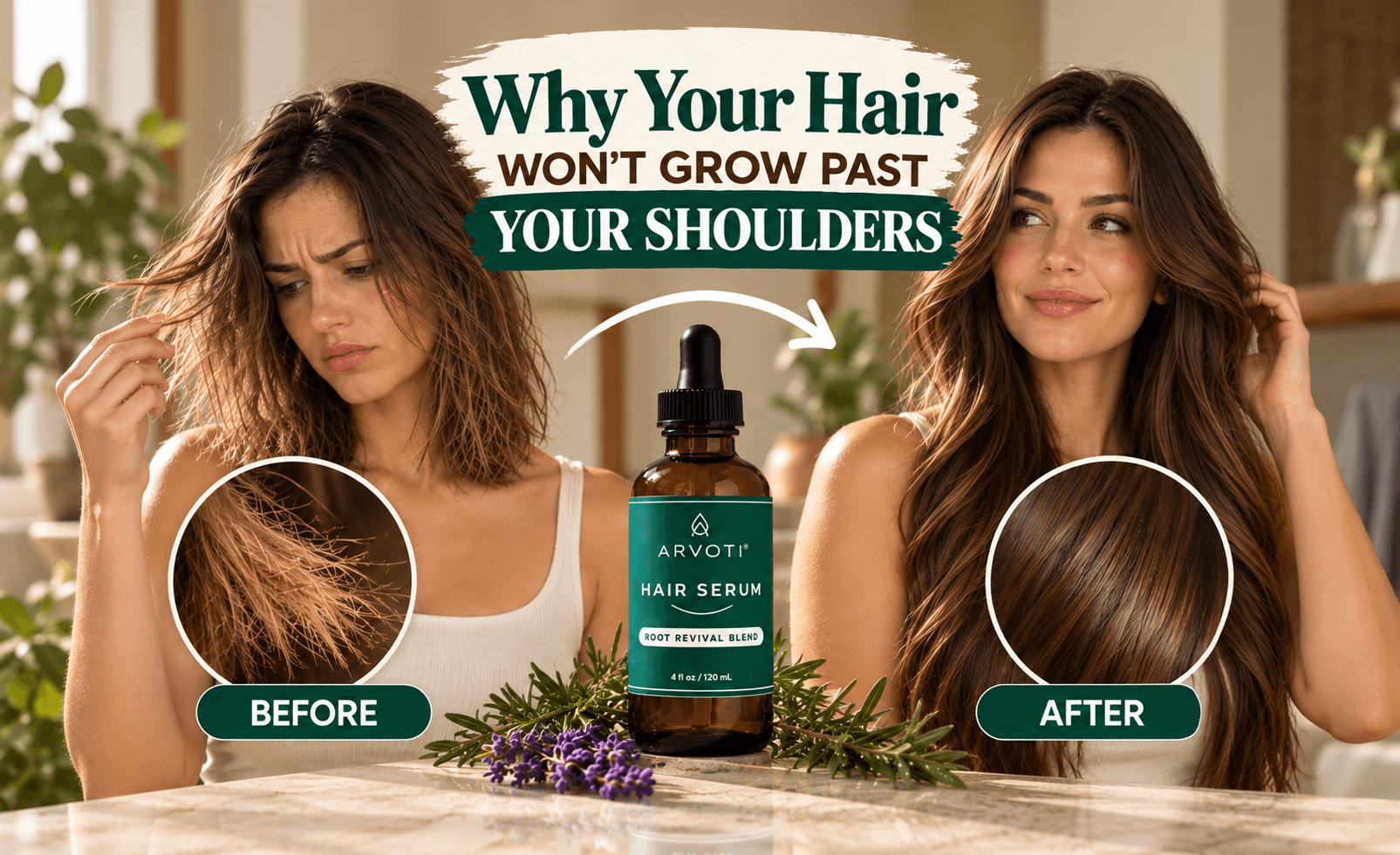
If you've ever looked in the mirror and wondered, "Why won't my hair grow past my shoulders?" I want you to know you're far from alone. In fact, it's one of the most common questions people ask when they're trying to grow longer, healthier hair. That was me years ago, and I even showed it in one of my recent reels. My hair was STUCK around my shoulders.
You may have spent months—or even years—trying every shampoo, conditioner, supplement, and internet hack you could find. Maybe you've faithfully taken collagen, switched to silk pillowcases, trimmed your ends every few months because someone told you it would make your hair grow faster, or even tried expensive salon treatments that promised dramatic results. Yet somehow, no matter what you do, your hair seems to reach the same point every single time before it simply... stops. It can feel incredibly frustrating, especially when you see people online whose hair seems to grow effortlessly while yours appears permanently stuck at shoulder length.
For a long time, I believed something was wrong with my hair too. Mine simply wouldn't grow. Year after year it hovered around my shoulders, never seeming to make meaningful progress no matter what products I bought or what advice I followed.
Looking back now, I realize I was asking the wrong question. I kept asking, "Why isn't my hair growing?" when the better question was, "Why am I never seeing the growth that's already happening?" That small shift completely changed the way I approached hair care. Once I understood how hair actually grows, what causes it to break, and why the health of the scalp matters just as much as the hair itself, everything began to change.
Today my hair is longer, healthier, and stronger than it has ever been, and it wasn't because I discovered some magical overnight trick. It was because I finally started supporting my hair instead of unknowingly working against it.
One of the biggest surprises for me was learning that in many cases, hair that feels "stuck" isn't actually stuck at all. Hair grows in cycles, and for most healthy adults, each strand grows a little every month. If your hair seems frozen at the exact same length year after year, the issue often isn't that your hair has stopped growing entirely.
More often, it means that your hair is breaking at roughly the same rate that new growth is being produced. Growth may be happening at the scalp, but constant breakage keeps you from ever enjoying the extra length.
That realization changed everything for me because it shifted my attention away from simply trying to "grow hair faster" and toward creating an environment where my hair could actually keep the length it was producing.
Healthy hair isn't just about the strands you can see in the mirror. It begins beneath the surface, at the scalp, where every strand starts its journey. Just like a thriving garden depends on healthy soil, beautiful hair depends on a healthy scalp. You wouldn't expect flowers to flourish in dry, depleted soil, and the same principle applies to hair.
When the scalp is nourished and cared for, it creates a better environment for healthy-looking hair to grow. At the same time, protecting the hair shaft from unnecessary damage allows you to finally keep the length your body has been producing all along.
The Biggest Myth About Hair Growth
One of the most persistent myths in the beauty world is the idea that hair simply reaches a certain length and then stops growing. You've probably heard someone say, "My hair just won't grow past my shoulders," or "My hair has reached its maximum length."
The beauty industry doesn't always help clear up this misunderstanding. New products appear every year promising to make hair grow inches faster, often implying that the hair itself simply needs more encouragement. While healthy habits certainly support beautiful hair, growth speed isn't usually the biggest obstacle.
Hair already knows how to grow. Your body has been producing new strands your entire life without needing a miracle product to tell it what to do. The real challenge is preserving those strands long enough for them to become the long, full hair you're hoping to achieve. When breakage repeatedly shortens the hair at the same pace new growth appears, it creates the illusion that growth has completely stopped.
This is actually wonderful news because it means there are many factors within your control. Instead of constantly searching for ways to force your hair to grow faster, you can begin focusing on protecting what you already have. Every decision you make—from how you brush your hair to the products you massage into your scalp—contributes to the overall health of your hair over time. Healthy hair isn't built in a single day, just as a thriving garden isn't created by watering it once. It develops through consistent care, thoughtful habits, and giving your body the support it needs month after month.
Your Hair Is Probably Growing... You're Just Never Seeing the Length
One of the reasons this topic resonates with so many women is because the evidence can feel confusing. Especially if you are a post partum mama.
You notice roots appearing after coloring your hair. You need regular trims because your stylist points out split ends. You even find loose hairs in your brush that seem surprisingly long. Clearly, your hair is growing. Yet when you look in the mirror, the overall length appears unchanged. That contradiction often leaves people convinced that something mysterious is happening when, in reality, the explanation is surprisingly simple.
Every day your strands experience friction from clothing, heat styling, brushing, ponytails, wind, weather, and ordinary life. Those small stresses may seem insignificant individually, but over months and years they gradually weaken the oldest portions of your hair—the ends. Since the ends are the oldest part of every strand, they've had the longest exposure to damage. Eventually they begin splitting, snapping, and breaking away, quietly stealing the length your scalp has been working so hard to produce.
Understanding this was one of the biggest turning points in my own hair journey. I stopped obsessing over making my hair grow faster and started asking a different question entirely: "How can I help my hair keep the length it's already growing?"
That simple change in perspective transformed everything about my routine. Instead of chasing trendy products that promised unrealistic overnight growth, I focused on nourishing my scalp, protecting my ends, reducing unnecessary damage, and creating habits I could actually maintain. Little by little, those consistent choices added up. For the first time in years, my hair finally began growing beyond the point where it had always seemed stuck.
The Five Reasons Your Hair Gets "Stuck"
Once I understood that my hair wasn't actually refusing to grow, I became fascinated by the question of what was stealing my length. I started reading research, studying the structure of hair, paying attention to my own habits, and looking at what changed when my hair finally started thriving.
What I discovered was surprisingly reassuring. There usually isn't one single reason hair won't grow past shoulder length. Instead, it's often the result of several small habits that quietly work against your hair every single day. The good news is that small habits can also work in your favor. Once you recognize what's contributing to breakage and poor scalp health, you can begin making simple changes that allow your hair to finally reach the length it's been capable of all along.
Breakage: The Silent Length Thief
Hair breakage is by far the biggest reason so many people believe their hair has stopped growing. Unlike hair loss, where the strand sheds from the root as part of the normal hair growth cycle, breakage occurs somewhere along the hair shaft. Every time a strand snaps in the middle or near the ends, you lose months of growth in an instant. The frustrating part is that breakage often happens gradually enough that you don't notice it day by day. Instead, you simply wake up one morning realizing your hair looks exactly the same length it did six months ago.
Dry Ends: The Oldest Part of Your Hair Needs the Most Care
One of the easiest things to overlook is the simple fact that the ends of your hair are also the oldest part of every strand. If your hair reaches your shoulders, those ends may be several years old. During that time they've survived thousands of brush strokes, hundreds of washes, changing seasons, sunshine, wind, friction from coats and sweaters, pillowcases, ponytails, and countless other daily stresses. It makes perfect sense that they would eventually become more fragile than the newer growth near your scalp.
When hair loses moisture and it hasn't been nourished from the root, it also loses flexibility. Instead of bending gently when brushed or styled, dry strands become increasingly brittle and more likely to split or snap. Once split ends begin traveling upward, the damage continues until the weakened portion finally breaks away. This is why simply adding moisture back into the hair can make such a dramatic difference over time. Healthy-looking hair isn't only about what happens at the scalp. Protecting the oldest sections of the hair allows you to preserve the months and years of growth you've already earned.
Heat Damage Adds Up Faster Than You Think
I know how tempting it is to reach for the blow dryer, curling iron, or straightener every morning. We all love the confidence that comes with freshly styled hair. The challenge is that hair isn't capable of repairing itself the way skin can. Once excessive heat damages the structure of a hair strand, that particular section remains weakened until it's eventually trimmed away.
That doesn't necessarily mean you have to give up heat styling forever. It simply means understanding that every styling session contributes to the overall condition of your hair. Lower temperatures, limiting heat exposure when possible, allowing hair to air dry more often, and using protective styling techniques can all help reduce unnecessary stress on the hair shaft. Small improvements practiced consistently often make a far greater difference than dramatic changes that are impossible to maintain.
Poor Scalp Health Creates an Unhealthy Environment
This was probably the biggest lesson I learned throughout my own journey. For years I spent almost all of my attention on the visible part of my hair while giving very little thought to the scalp itself. Looking back, it seems obvious. Every strand of hair begins beneath the surface of the scalp, yet so many of us spend far more money on conditioners than we do caring for the place where healthy hair actually starts.
Your scalp is living skin. Just like the skin on your face, it benefits from regular cleansing, balanced hydration, and thoughtful nourishment. Product buildup, excess oil, environmental debris, and harsh ingredients can all affect how healthy and comfortable the scalp feels.
Once I shifted my attention toward caring for my scalp instead of only chasing longer strands, I noticed not only healthier-looking hair but a healthier-feeling scalp as well.
Nutrition Matters More Than Many People Realize
Hair is often one of the last places your body chooses to devote its resources. Your body will always prioritize essential organs and vital functions before focusing on growing long, shiny hair. That's why overall nutrition plays such an important role in supporting healthy-looking hair. A balanced diet that includes adequate protein, healthy fats, vitamins, and minerals provides the building blocks your body uses every day—not just for your hair, but for countless other processes happening behind the scenes.
This realization completely changed the way I approached beauty. I stopped thinking of healthy hair as something that could only come from a bottle and began viewing it as a reflection of how I was caring for my body as a whole. Nourishing foods, adequate hydration, quality sleep, stress management, and a consistent hair care routine all work together. There is rarely one magic ingredient responsible for beautiful hair. More often, it's the combination of small daily choices that gradually creates noticeable results.
The Common Thread: Healthy Hair Starts Long Before You See It
If you've noticed a pattern throughout these five reasons, it's this: almost every one of them comes back to creating a healthier environment for your hair. Whether it's protecting the hair shaft from breakage, keeping the ends nourished, reducing unnecessary heat, supporting your body with balanced nutrition, or giving your scalp the care it deserves, none of these habits promise overnight miracles. Instead, they work together to create something much more valuable—a routine that supports healthy-looking hair day after day.
The Ingredients I Chose for My Root Revival Serum—and Why
When I decided to create Gubba Homestead's Arvoti Root Revival Serum, I wasn't interested in following trends or filling a bottle with ingredients that simply sounded impressive on a label. I wanted to create something that I genuinely looked forward to using myself because that's the only kind of product I would ever feel comfortable recommending to someone else. Every ingredient was selected with one goal in mind: to nourish the scalp and support healthier-looking hair through consistent, intentional care.
Castor oil became one of the foundation oils because of its rich, thick texture that helps coat both the scalp and hair while creating a deeply nourishing treatment. It has been used in traditional beauty routines for generations, and I love how it leaves the scalp feeling conditioned and cared for. Since castor oil can feel quite heavy on its own, I balanced it with lighter oils that absorb beautifully and create a much more enjoyable experience.
I thoughtfully crafted in other oils like rosemary that are beneficial for our hair.
The Routine That Helped Me Finally Grow My Hair Past My Shoulders
Using my Gubba Homestead Arvoti Root Revival Serum is the most important part of my hair routine. Several evenings each week, I massage a small amount directly into my scalp and spend a few minutes working it in with my fingertips. Those few quiet minutes have become one of my favorite parts of the day.
It's a chance to slow down, care for myself, and invest in long-term results instead of chasing instant gratification. I don't expect miracles overnight because healthy hair simply doesn't work that way.
Healthy-looking hair is built through patience, nourishment, and consistency. Once I embraced that mindset, everything changed. My hair didn't just become longer—it became healthier, stronger, shinier, and far easier to care for. Those improvements didn't happen because I found a miracle. They happened because I finally started supporting my hair instead of constantly fighting against it.
Ready to Start Your Own Hair Growth Journey?
If you've spent years wondering, "Why won't my hair grow past my shoulders?" I hope my blog has shown you that the answer is often much more encouraging than you expected. In many cases, your hair hasn't stopped growing at all. It's simply been losing the race against breakage, dryness, and everyday damage. The wonderful news is that many of those factors are within your control. Small changes made consistently can have an incredible impact over time, and every healthy habit you build today is an investment in the hair you'll enjoy months from now.
If you're ready to begin caring for your scalp as intentionally as you care for the rest of your body, I'd love to invite you to explore my Gubba Homestead Arvoti Root Revival Serum. I created this hair serum, and it finally helped me grow my own hair beyond the point where it always seemed stuck.
Sometimes the biggest transformation begins not with doing more, but with finally giving your hair the consistent care it has needed all along.
Frequently Asked Questions
Why won't my hair grow past my shoulders?
In many cases, your hair is still growing, but breakage is preventing you from seeing additional length. Dry ends, heat styling, friction, tight hairstyles, and poor scalp care can all contribute to hair breaking at roughly the same rate that new growth is being produced.
How long does it take to grow hair past shoulder length?
Hair growth varies from person to person, but healthy hair typically grows gradually over time. The key is not only supporting healthy growth but also preventing breakage so you can retain the length your hair is already producing.
Does rosemary oil help support healthy-looking hair?
Rosemary oil has become one of the most popular botanical ingredients in hair care and is commonly included in scalp care routines because of how it can help support hair growth and strength. That is why I included it in my Gubba Homestead Arvoti Hair Serum.
Why is scalp health so important?
Every strand of hair begins in the scalp. Caring for the scalp helps create a healthy environment where your hair can grow and thrive, making scalp care an important part of any long-term hair routine.
How often should I use the Root Revival Serum?
I personally enjoy using my Gubba Homestead Arvoti Root Revival Serum several evenings each week as part of my regular self-care routine. Consistency is far more important than perfection. Building a routine you genuinely enjoy following is one of the best ways to support healthier-looking hair over the long term.
