
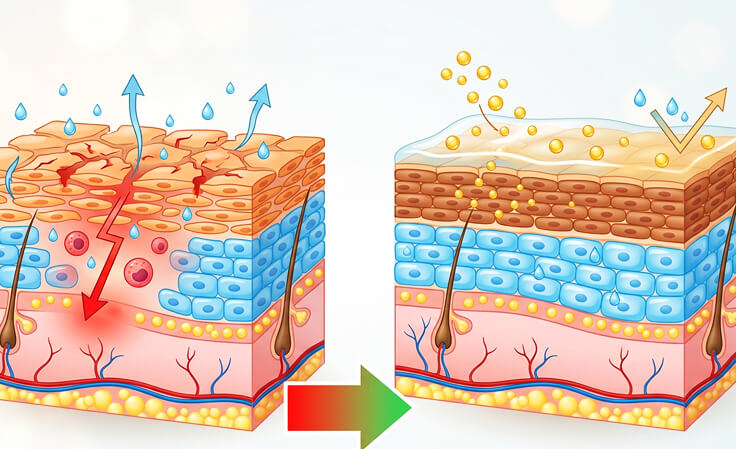
There is a reason your skin suddenly feels tight, reactive, dull, or unpredictable even when you are using “good” skincare. You might be layering serums, trying trending ingredients, and following routines that promise results, yet your skin seems to be getting worse instead of better. If that sounds familiar, the issue is often not your effort. It is your skin barrier quietly asking for help.
In today’s world of exfoliating acids, retinol cycles, and aggressive treatments, the concept of skin barrier repair has become one of the most searched topics in skincare. And for good reason. People are waking up to the realization that more products do not always mean better skin. In fact, for many, it is the exact opposite. Something I wish I knew back when I was younger and starting out on my skincare journey.
So what is actually going on beneath the surface, and more importantly, how do you heal your skin naturally without continuing the cycle of irritation?
Let’s break it down in a way that actually makes sense and gives your skin a path forward. I have had to repair my skin, and now my skin is the healthiest it has been in my entire life.
What Is the Skin Barrier and Why Does It Matter So Much?
Your skin barrier is not just a trendy phrase being thrown around online. It is a real, functional layer of your skin that plays a critical role in how your skin looks, feels, and behaves every single day. Think of it like the protective outer wall of your home. When it is strong and intact, everything inside stays safe, balanced, and comfortable. When it is compromised, everything becomes vulnerable.
This outermost layer, often referred to as the moisture barrier, is made up of skin cells held together by lipids, creating a structure that keeps hydration in and environmental stressors out. When your barrier is functioning properly, your skin feels soft, resilient, and calm. It holds onto moisture, maintains an even tone, and responds well to products.
But when that barrier is damaged, everything changes. Moisture escapes more easily, irritants penetrate deeper, and your skin starts reacting to things it never reacted to before. This is where you begin to notice dryness that does not go away, redness that lingers, breakouts that feel different, and a general sense that your skin is out of balance.
Understanding this is the first step in true skin barrier repair, because once you realize that your skin is not “bad” but rather compromised, your approach begins to shift.
How Do You Know If You Have a Damaged Skin Barrier?
Many people are unknowingly dealing with a damaged skin barrier because the symptoms can be subtle at first. It is not always extreme peeling or visible damage. Sometimes it shows up in ways that are easy to overlook or misinterpret.
You might notice that your skin feels tight even after moisturizing, or that products you once loved suddenly sting or burn. Your complexion might look dull or uneven despite using brightening products. Breakouts might become more frequent, yet your skin also feels dry at the same time. This confusing combination of oily and dry, irritated yet congested, is one of the clearest signs that your barrier is struggling.
Another common sign is sensitivity. If your skin reacts quickly to weather changes, new products, or even water temperature, your barrier may not be providing the protection it once did. When your skin becomes reactive, it is not being difficult. It is signaling that it needs support, not more stress.
Recognizing these signs is essential because it shifts your goal from fixing surface issues to healing your skin naturally at the root level.
What Causes a Damaged Skin Barrier in the First Place?
This is where things get interesting, because most people damaging their skin barrier are doing it with good intentions. They are trying to improve their skin, but the methods they are using are slowly wearing it down.
One of the biggest culprits is the overuse of harsh active ingredients. Retinol, exfoliating acids, and acne treatments like benzoyl peroxide are often marketed as essential for clear, youthful skin. And using them too frequently or layering them incorrectly can strip the skin faster than it can recover. You couldn't pay me to use any of these toxic ingredients. I still remember being a teen and using a red alcohol-based cleanser of sorts with added fragrance to "cleanse" my face because that product was popular at the time. Ah!
Imagine sanding down a piece of wood every single day. Eventually, there is nothing left to smooth. That is what over-exfoliation does to your skin. It removes not only dead skin cells but also the protective layers your skin needs to function properly.
Another major factor is the use of stripping cleansers. Many traditional face washes are designed to remove oil aggressively, leaving your skin feeling squeaky clean. But that tight, dry feeling is not a sign of cleanliness. It is a sign that your natural protective oils have been removed, leaving your barrier exposed. My skin is soft and supple after I cleanse with my oil cleanser.
Environmental stress also plays a role. Cold air, dry indoor heat, sun exposure, and pollution all contribute to barrier damage over time. When these external factors are combined with an already aggressive skincare routine, the damage can accelerate quickly.
This is why so many people find themselves stuck in a cycle. Their skin feels dry or irritated, so they reach for stronger products, which only makes the problem worse.
Why “More Skincare” Is Often the Problem, Not the Solution
There has been a shift happening in skincare, and it is one that is long overdue. For years, the message was that you needed more. More steps, more products, more actives, more results. But now, more people are discovering that the path to healthy skin often involves doing less, not more. People are realizing the results are in the ingredients. Real, nourishing ingredients are what make the difference.
When your skin barrier is compromised, every additional product becomes another variable your skin has to process. Even products that are labeled as gentle can become overwhelming when your barrier is already struggling.
Think about your skin like a tired system that is constantly being asked to perform. If you keep adding demands without giving it time to recover, it will eventually slow down and stop responding the way you want it to.
This is why natural skin barrier repair focuses on simplicity. It is about giving your skin the space and support it needs to restore itself instead of constantly trying to force it into a certain result. Think of all of the ingredients you have bombarded your skin with, it is time to let it breathe.
How to Fix a Damaged Skin Barrier Naturally
Healing your skin does not require an extreme routine or complicated system. In fact, the most effective approach is often the simplest one. The goal is to support your skin’s natural ability to repair itself while removing the factors that are causing stress.
Step One: Switch to a Gentle Oil Cleanser
Cleansing is where everything begins, and it is also where many people unknowingly damage their barrier the most. Traditional cleansers often strip away not only dirt and makeup but also the natural oils your skin needs to stay balanced.
An oil cleanser works differently. It uses the principle of like dissolves like, gently breaking down buildup without disrupting your skin’s natural structure. Instead of leaving your skin tight and dry, it leaves it soft, balanced, and ready to absorb nourishment.
This simple shift can make a profound difference in healing a damaged skin barrier, because it removes one of the most common sources of daily stress. I use my oil cleanser every morning and evening. When I am showering, I use it as well. It leaves my skin so silky soft!
Step Two: Rebuild and Seal With Deep Nourishment
Once your skin is clean, the next step is to replenish what has been lost. This is where rich, nourishing balms come into play. These formulations are designed to mimic and support your skin’s natural lipid structure, helping to rebuild the barrier and lock in moisture.
Think of this step like repairing the bricks and mortar of your skin’s outer wall. Instead of just adding temporary hydration, you are restoring the structure that keeps hydration where it belongs.
When used consistently, this type of nourishment helps your skin feel more resilient, reduces dryness, and creates that smooth, healthy appearance that so many people are chasing with more aggressive treatments. This is where my tallow balm comes into play, it is the brick and mortar of the skin giving it the building blocks to not only repair, but to become strong and nourished.
Step Three: Support With Targeted Serums That Do Not Overwhelm
Serums can be incredibly beneficial when chosen and used correctly. The key is to focus on formulas that support your skin rather than stress it. Instead of strong actives that force rapid turnover, look for ingredients that calm, hydrate, and strengthen.
This approach allows your skin to improve gradually without triggering the cycle of irritation and recovery. It is a slower path, but it is also a more sustainable one.
When your skin barrier is healthy, everything else becomes easier. Your skin responds better to products, holds moisture more effectively, and maintains a natural glow without constant intervention. For tired eyes, I use my Awakening Eye Serum. Instead of retinol, I use my Anti-Aging Serum. You can learn why I don't use retinol. For natural plumping instead of fake synthetic silicone-based serums, I use my Plumping Serum.
How Long Does Skin Barrier Repair Take?
One of the most common questions people have is how long it takes to repair a damaged barrier. The answer depends on how compromised your skin is and how consistent you are with your routine.
For some, improvements can be felt within a few days as the skin begins to retain moisture again. For others, especially those who have been using strong actives for a long time, it may take several weeks to fully restore balance.
The important thing to remember is that this is not a quick fix. It is a process of healing skin naturally, and that requires patience. The good news is that once your barrier is restored, your skin becomes much easier to maintain.
Why Simplicity Is the Future of Skincare
There is a growing movement toward minimal, intentional skincare, and it is not just a trend. It is a return to what actually works. When you strip away the noise and focus on what your skin truly needs, the results often speak for themselves.
Instead of chasing every new ingredient or routine, you begin to build a foundation that supports your skin long term. This is where real transformation happens. Not through force, but through consistency and care.
Your skin was designed to function, protect, and renew itself. When you give it the right environment, it does exactly that.
Ready to Repair Your Skin Naturally?
If your skin has been feeling off, reactive, or constantly in need of fixing, it may not need more products. It may need a reset.
Start with the basics. Cleanse gently. Nourish deeply. Support consistently. Give your skin the chance to rebuild what has been worn down.
If you are ready to simplify your routine and truly focus on skin barrier repair, explore my Arvoti skincare products that work with your skin instead of against it. Thoughtfully crafted oil cleansers, nourishing balms, and supportive serums can help you rebuild your skin from the ground up.
Your skin does not need to be pushed harder. It needs to be supported better.
Frequently Asked Questions
What is the fastest way to repair a damaged skin barrier?
The fastest way is to remove harsh products immediately and switch to a simple routine focused on gentle cleansing, deep nourishment, and hydration. Consistency is key, and avoiding further irritation allows your skin to recover more efficiently.
Can you fix a damaged skin barrier naturally?
Yes, natural skin barrier repair is absolutely possible. By using gentle, nourishing products and avoiding harsh actives, your skin can rebuild its protective layer over time.
Should I stop using retinol if my skin barrier is damaged?
If your skin is showing signs of damage, it is best to pause retinol and other strong actives until your barrier has healed. Reintroducing them too soon can prolong irritation.
How do I know if my skin barrier is healing?
You will notice less sensitivity, improved hydration, smoother texture, and a more even tone. Your skin will start to feel calm instead of reactive.
Is oil cleansing good for a damaged skin barrier?
Yes, oil cleansing is one of the best methods for a compromised barrier because it cleans without stripping essential oils, helping maintain balance while gently removing buildup.
